
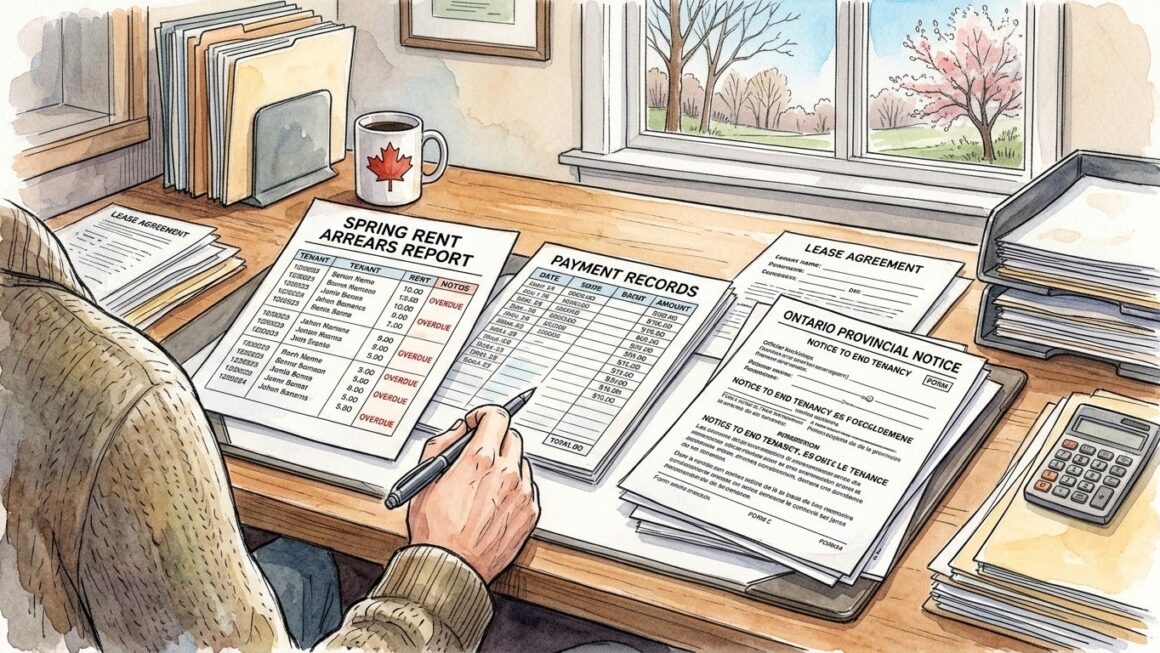

Spring can be a pressure point for landlords. Winter bills are still fresh, repairs start showing up, tax records need sorting, and turnover season is around the corner.
So when a tenant falls behind in March, April, or May, it can affect more than one month’s cash flow. The best response is not panic. It is a clear process: confirm the arrears, communicate in writing, follow your province’s rules, and keep the payment trail clean.
For a broader legal overview, Pendo Rent’s guide on how to handle late rent payments is a helpful companion read.
TLDR
- Check the ledger first. Confirm the amount due, payment status, partial payments, and any failed transaction.
- Send one calm written reminder. Keep it factual and dated.
- Use the correct provincial notice or tribunal process. The timeline changes by province.
- Keep every record. Notices, proof of service, messages, NSF records, and payment history all matter.
- Use spring as a reset point. If arrears are happening after winter, review your rent collection workflow before summer turnover.
Why spring arrears need quick attention
Spring often brings extra landlord costs: roof leaks, gutter cleaning, landscaping, tax prep, appliance repairs, and move-out planning. A missed rent payment during this season can stretch cash flow fast.
That does not mean every late payment becomes a dispute. Some are caused by a banking issue, job change, or short-term cash gap. But the process should be the same every time: verify, document, communicate, then escalate only when needed.
If you collect rent through PendoPay, start by checking the payment status. Pendo Rent shows whether a payment is pending, processing, paid, or failed, and stores the payment history in the tenant ledger. Pendo Rent’s walkthrough explains what happens when a tenant submits rent through Pendo Rent, including reminders, PAD initiation, payment status, failed payment alerts, receipts, and ledger updates.
Step 1: Confirm what is unpaid
Before sending a notice, check:
- Rent due date
- Lease rent amount
- Partial payments
- Failed PAD, NSF, or returned payment
- E-transfer sent under a different name
- Any written payment arrangement
- Whether the charge is rent, utilities, parking, or something else
This matters because some formal notices are rent-specific. Ontario’s N4 instructions, for example, tell landlords to include only rent amounts and to check the total rent owing carefully.
Step 2: Send a written reminder
Keep the first message short.
Hi [Tenant Name],
Our records show that rent of $[amount] due on [date] has not been received. Could you please confirm payment status today? If there was a banking issue, please let me know so we can document the next step properly.
Thank you,
[Landlord Name]
If the tenant replies by phone, send a written recap after the call. This keeps the file clean without escalating the tone.
Step 3: If the payment failed, document the NSF trail
If rent failed because of insufficient funds, do not rely on screenshots or memory. Record the failed payment date, amount, tenant notice, and any retry attempt.
Pendo Rent explains how NSF fees and refunds are handled, including failed PAD status updates, tenant notifications, timestamped records, and when a landlord may add an NSF charge if allowed by the province and disclosed in the lease.
This is where software earns trust. You are not just collecting rent. You are keeping a clean record in case the arrears become a formal issue.
Step 4: Follow the right provincial process
Always download the current form from the official provincial source before serving notice.
| Province | Start here for unpaid rent | Timing to watch |
| BC | BC RTB-30: 10 Day Notice to End Tenancy for Unpaid Rent or Utilities | Tenant has 5 days to pay or dispute. If they do neither, the landlord may apply through the RTB direct request process. |
| Alberta | 14-day notice or RTDRS/Court | Tenant can stop the notice by paying all rent before the notice period ends. |
| Saskatchewan | Immediate Notice to Vacate and Notice of Arrears | Available once the tenant is 15 days or more in arrears. |
| Manitoba | Form 8: Notice of Termination by Landlord for Non-Payment of Rent | Can be used when rent is unpaid within three days of being due. |
| Ontario | Ontario N4, then Ontario L1 if needed | The L1 is used after serving an N4 and after the N4 termination date has passed. |
| Quebec | Apply to the Tribunal administratif du logement | TAL says if rent is more than three weeks late, the lessor can ask for payment, lease termination, and eviction. |
| New Brunswick | Notice to Vacate / Final Notice to Vacate process | The final notice must give a vacate date at least 15 days from service. |
| Nova Scotia | Form D: Landlord’s Notice to Quit for Rental Arrears | Can be served after rent is at least 3 days late; eviction date can be no sooner than 10 days after service. |
| PEI | Form 4(A): Eviction Notice | For non-payment, the tenant has 20 days to vacate unless they pay the full amount within 10 calendar days. |
| Newfoundland and Labrador | Landlord’s Notice to Terminate Early – Cause | For monthly tenancies, rent must be overdue for at least 5 days before notice, with at least 10 days after service to vacate. |
Step 5: Keep one spring arrears file
Create one folder for the issue. Include:
- Lease or rental agreement
- Rent ledger
- Payment receipts
- Failed payment or NSF record
- Tenant reminder message
- Tenant replies
- Formal notice
- Proof of service
- Repayment agreement, if any
- Tribunal application, if filed
This is the part landlords often wish they had organized earlier. With PendoPay, payment status, receipts, failed transactions, and ledger history are tied to the tenant and unit, which reduces the need to reconstruct the story later.
Step 6: Decide if this is a one-time issue or a pattern
One missed payment after winter may be solved with a short written repayment plan.
Repeated spring arrears need a firmer process.
Ask:
- Has this tenant been late before?
- Did they communicate before or after rent was missed?
- Was it a failed payment or no payment attempt at all?
- Have past repayment plans been followed?
- Is the arrears amount growing?
If the tenant is reliable and the amount is manageable, a dated repayment plan may protect the tenancy and your cash flow. If the tenant is silent or repeatedly behind, follow the provincial process.
Mini example: April rent is missed after winter repairs
Rent is due April 1. It does not arrive.
The landlord also has a spring gutter repair invoice and tax records to finish. Instead of texting in frustration, they check the ledger on April 2. No payment. No partial payment. No PAD in progress.
They send one written reminder. The tenant replies that the payment failed because their account was short.
Now the landlord has a clean path:
- Record the failed payment.
- Confirm whether an NSF fee applies.
- Offer a short written repayment plan, if appropriate.
- Serve the proper provincial notice if payment is not made.
The landlord is not guessing, chasing, or arguing. The file is organized from day one.
Common mistakes to avoid
Serving the wrong form.
BC’s RTB-30 is not the same as Ontario’s N4, and neither applies across Canada.
Adding non-rent charges to a rent-only form.
Ontario’s N4 instructions are clear that the form is for rent amounts, not unrelated charges.
Waiting too long because the tenant seems nice.
You can be kind and still put dates in writing.
Relying on scattered messages.
A clean ledger and written timeline are easier to defend than screenshots across text, email, and bank apps.
Using pressure instead of process.
Do not lock out a tenant, remove belongings, shut off utilities, or change locks without the proper order and enforcement process.
FAQ
What should I do first when a tenant falls behind in spring?
Check the ledger. Confirm the rent amount, due date, payment status, failed payment records, and any partial payment before sending a reminder or notice.
Can I serve a notice right away?
It depends on the province. BC allows the RTB-30 any day after rent is due, while Nova Scotia requires rent to be at least 3 days late before Form D can be served.
What if the tenant pays after notice is served?
That depends on the province and timing. In BC, the tenant has 5 days to pay or dispute. In Alberta, the notice is no longer effective if the tenant pays the rent before the 14 days are up.
Should I offer a repayment plan?
Use one only if it is written, dated, specific, and realistic. Include the arrears amount, payment dates, and what happens if the tenant misses the plan.
Final thought
Spring arrears are a cash-flow problem, but they are also a systems test.
If your process depends on memory, bank screenshots, and follow-up texts, one missed payment can eat up hours. If your rent ledger, payment status, NSF record, and tenant history are organized, the next step is much clearer.
PendoPay helps landlords collect rent by direct bank transfer, track payment status, and keep a timestamped record when something fails.