
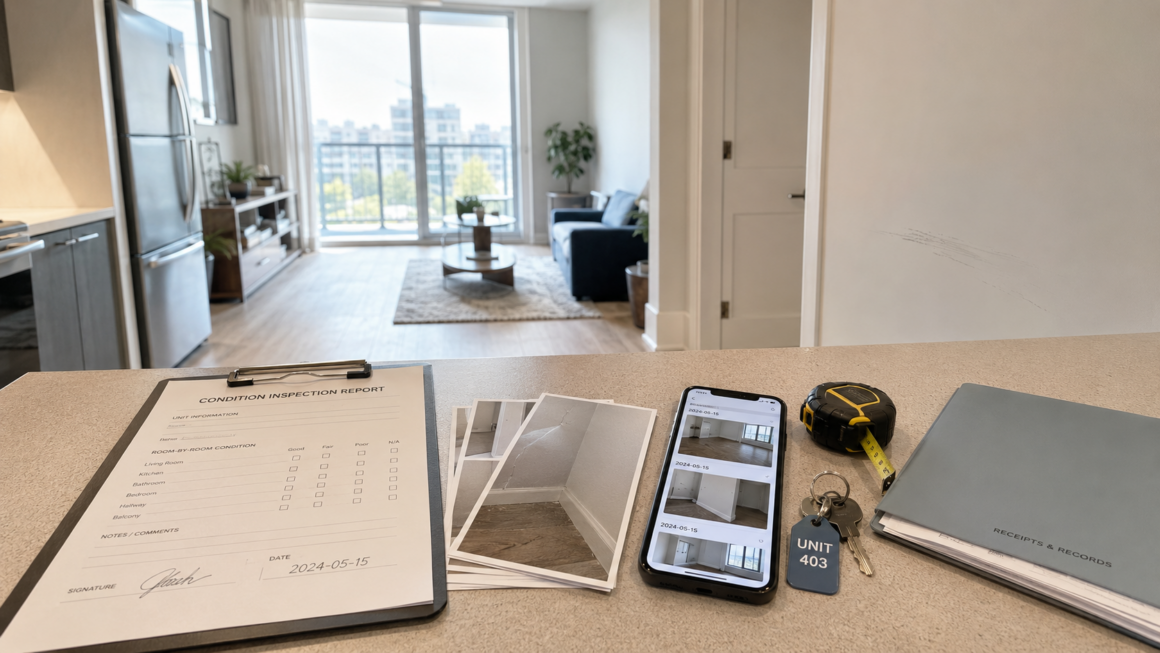

You hand over the keys, and eighteen months later a dishwasher door is hanging off its hinge. Whether you recover that money depends almost entirely on paperwork you created on day one.
What that paperwork has to look like depends on where the unit is. Canada runs four different models: provinces where a signed condition report is mandatory and skipping it destroys your claim, provinces where the report is optional but a very short clock starts the day the tenancy ends, provinces that hold the deposit for you, and provinces where there is no damage deposit to argue about. This walks through which records carry weight in each, and why even a well-documented claim gets trimmed.
Key Takeaways
- In B.C., Alberta and Yukon, a missing or improperly completed condition inspection report can wipe out your right to claim against the deposit entirely.
- Manitoba takes the opposite approach: a condition report is not required unless the landlord or tenant asks for one.
- Timing can be really crucial. Saskatchewan gives you 7 business days to claim, New Brunswick 7 days, Nova Scotia and Alberta 10, B.C. 15.
- In New Brunswick a deposit paid to you has to reach the Residential Tenancies Tribunal within 15 days, and failing to remit it is an offence under the Act.
- Ontario permits no damage deposit, and in Quebec the Civil Code bars any deposit beyond rent, so records there support a claim rather than a deduction.
What is a condition inspection report?
A condition inspection report is a written, signed record of a rental unit’s condition at move-in and again at move-out, completed by the landlord and tenant together during a walk-through.
The required contents are broadly similar wherever reports are mandatory. B.C.’s version must name both parties, the unit address, the landlord’s address for service, the key handover date and the inspection date, then record each room plus any balcony, yard, garage, storage or parking the tenant has sole use of. The RTB publishes Form RTB-27 and the move-in inspection rules; Yukon, Manitoba and New Brunswick publish their own templates. Your own form works if it captures the same fields.
Is a move-in inspection required in your province or territory?
| Where | What the law asks for | The consequence or deadline that bites |
| British Columbia | Move-in and move-out reports. Two opportunities offered for each; tenant gets a copy within 7 days. | Right to claim against the security or pet damage deposit is extinguished. 15 days to return or file; $100 CAD to apply. |
| Alberta | Inspection within one week before or after the tenant takes and gives up possession, with specific signed statements. | Deducting for damage without it is an offence. Full deposit plus interest within 10 days if nothing is owed; if deducting, a statement or estimate within 10 days and the final statement within 30. |
| Yukon | Condition report mandatory at both ends, with at least two good-faith opportunities to inspect. Copy to the tenant within 14 days of move-in and 7 days of move-out. | Either party can lose the deposit or the right to claim against it. |
| Manitoba | A condition report is not required unless the landlord or tenant asks for one. A prescribed form exists in the Regulation. | Nothing is lost automatically, but without a report you are arguing from memory. |
| Saskatchewan | No mandatory report. Deposit capped at one month’s rent, half payable at signing. | Claim through the ORT portal within 7 business days of the tenancy ending. ORT applications carry a $50 CAD fee. |
| Nova Scotia | No mandatory report. Condition reports and photographs are accepted as evidence. | File a Security Deposit Claim (Form R) within 10 days of the tenancy ending. Miss it and the tenant is awarded the full deposit. |
| New Brunswick | An Accommodation Inspection Report at both ends is recommended, not required. | A deposit paid to you must reach the Tribunal within 15 days; failing to remit it is an offence. Claim within 7 days of the tenancy ending. |
| Ontario | No report. No damage or pet deposit permitted, only last month’s rent and a refundable key deposit. | Nothing to deduct from. Damage goes to the LTB by L2 or L10: $201 CAD, or $186 through the Tribunals Ontario Portal. |
| Quebec | Article 1904 of the Civil Code bars a landlord from requiring any money beyond rent as a deposit, and from taking postdated cheques. | A landlord who demands one can be fined by the TAL. Records support a claim, not a deduction. |
Prince Edward Island, Newfoundland and Labrador, the Northwest Territories and Nunavut each run their own rules and are worth confirming directly before you build a process around any row above. Our province-by-province guide to rental deposits covers limits and return timelines in more detail.
How to build the file (step-by-step)
- Complete and sign the dated move-in report, with the tenant’s comments recorded where they disagree. In B.C. the tenant has the right to write their own assessment on the form; in Alberta the report needs the exact signed statements the Act sets out. In Manitoba, ask for one in writing if the tenant has not.
- Deliver a copy and keep proof: within seven days in B.C., immediately in Alberta. Save the email, not just the report. Use the address for service named in your rental agreement.
- Photograph and film the same day, room by room: wide shot for context, then close-ups of anything already worn or marked.
- Record install or purchase dates for appliances, flooring and paint. This step gets skipped most, and it is the one that sets the dollar figure later.
- Log every maintenance request and its resolution date, so a defect reported in month four is not argued as move-out damage.
- Keep a ledger with time-stamped rent, NSF events and deposit interest. Pre-authorized debit rather than e-Transfer produces that record without manual reconciliation.
- Complete the move-out report, then move on the deadline. In Saskatchewan and New Brunswick you have about a week; a file you have to reconstruct will not be ready in time.
Why photos get rejected (and how to format them)
Photos rarely fail on content. They fail on housekeeping, and the tightest published rules are B.C.’s, which makes them a sensible standard to work anywhere.
The RTB caps non-video files at 10 MB and video at 200 MB, and accepts a fixed format list: pdf, jpg, jpeg, png, mp4, mov, docx and a few others. HEIC, the iPhone default, is not on it, so switch your camera to Most Compatible before the first inspection. Evidence must also be numbered, labelled and described using Form RTB-43. If you share by Dropbox, OneDrive or Google Drive, the RTB’s digital evidence guideline requires view-and-download-only settings; if the other party can edit the files, the arbitrator may decline to consider them.
B.C. applicants must also get evidence to the other party at least 14 days before the hearing, and respondents at least 7.
Why a strong file still pays less than the invoice
Compensation is meant to put you back where you were, not somewhere better, so a claim gets adjusted for what the damaged item had left in it. B.C. is unusual in publishing the numbers: RTB Policy Guideline 40 puts carpet at 12 years, laminate at 15, interior paint at 6, dishwashers at 10 and fridges at 15. Its worked example: a tenant’s dog breaks a five-year-old dishwasher, the landlord replaces it for $900 CAD, and roughly $450 may be appropriate because half the useful life was already spent.
Most provinces have no published table, but the same logic surfaces in adjudication, which is why install dates matter everywhere. A three-year-old carpet is worth pursuing; an eleven-year-old one is close to worthless in a claim, and knowing that before you pay a filing fee saves you the filing.
Two worked examples
Surrey, B.C.: the deposit does not cover it
Rent is $1,850 a month on a $925 deposit. At move-out the dishwasher door is broken and the laminate is gouged. The dishwasher went in five years ago at $900, so call it $450. The laminate is three years into a 15-year useful life, so a $2,000 replacement supports roughly $1,600. A claim near $2,000 against a $925 deposit justifies the $100 filing fee. If the dishwasher were the only damage, it would not.
Saskatoon: the clock is the problem, not the evidence
Same damage, same photos, but Saskatchewan gives the landlord 7 business days from the end of the tenancy to claim through the ORT portal. A landlord who spends the first week chasing invoices and hunting for move-in photos in an old phone misses the window and returns the deposit in full. The file was never the weak point; the calendar was. Nova Scotia is blunter still: miss the 10-day deadline to file a Form R and the tenant is awarded the whole deposit.
Common mistakes
Assuming your province’s rule is the national rule
A process built for B.C.’s two-opportunity requirement is overkill in Manitoba and far too slow for Saskatchewan. If you own in more than one province, the workflow has to branch.
Inspecting after the tenant has moved in
B.C. and Alberta both expect the unit to be empty for the walk-through, and a report signed around someone’s furniture is easy to challenge.
Treating a signature as agreement to everything
A report showing the tenant’s own comments is harder to challenge later than one with no dissent recorded.
Storing photos only in a personal camera roll
Phones get replaced, and B.C. requires you to keep an exact copy of submitted evidence for two years after the proceeding ends.
Pendo Rent tip: The records that decide a damage claim are the ones nobody wants to hunt for a year later, and in Saskatchewan or New Brunswick you have about a week to find them. Pendo Rent is Canadian-built, so the lease, the inspection reports and photos filed against it, the maintenance log and the PendoPay ledger all sit on one property record instead of across email, a phone and a spreadsheet. Tenant Screening with Certn runs in the same place, so applicant and tenancy records do not end up in two systems.
Frequently Asked Questions
Do I have to do a move-in inspection in BC?
Yes. You schedule it and must offer the tenant two opportunities. Skipping it extinguishes your right to claim against the security or pet damage deposit.
Is a condition report required in Manitoba?
Manitoba’s Residential Tenancies Branch is clear that a condition report is not required by law unless the landlord or the tenant asks for one. A prescribed form exists, and either party can also ask for a report when a pet moves in or the unit is sublet.
How long does a landlord have to claim a security deposit?
It is shorter than most landlords expect. Saskatchewan gives seven business days from the end of the tenancy, New Brunswick seven days, Alberta and Nova Scotia ten, and B.C. fifteen from the written forwarding address. Miss B.C.’s window and an arbitrator can order you to pay double; miss Nova Scotia’s and the tenant is awarded the full deposit.
Are photos enough without a condition inspection report?
Not in B.C., Alberta or Yukon. Photos support a claim; the report preserves your right to make one against the deposit at all. In Manitoba, Saskatchewan and Nova Scotia photos carry more weight because no report is mandated.
How long should I keep move-in photos and inspection reports?
Alberta requires inspection reports kept three years after the tenancy terminates; B.C. requires an exact copy of submitted evidence for two years after a proceeding. The CRA expects supporting records for six years from the end of the tax year, so six years is the safe default nationwide.
Can I charge a tenant for normal wear and tear?
No. Tenants are responsible for cleaning and damage, but not deterioration from ordinary use. RTB Policy Guideline 1 sets out where that line falls in B.C., and the distinction applies across the country.
This article is for informational purposes only and does not constitute legal advice. Always consult your local Residential Tenancy Branch or a qualified legal professional for advice specific to your situation.
Keep the file in one place
If your inspection reports, maintenance history and payment records live in four different places, the next damage claim costs more in reconstruction time than it recovers, and in half the country you do not have the time. Pendo Rent keeps lease, tenant, ledger and payment history under one login, built for Canadian tenancy rules.
Start a free 30-day trial today and see how Pendo Rent keeps your records ready before a dispute ever starts, or contact us for a demo.