
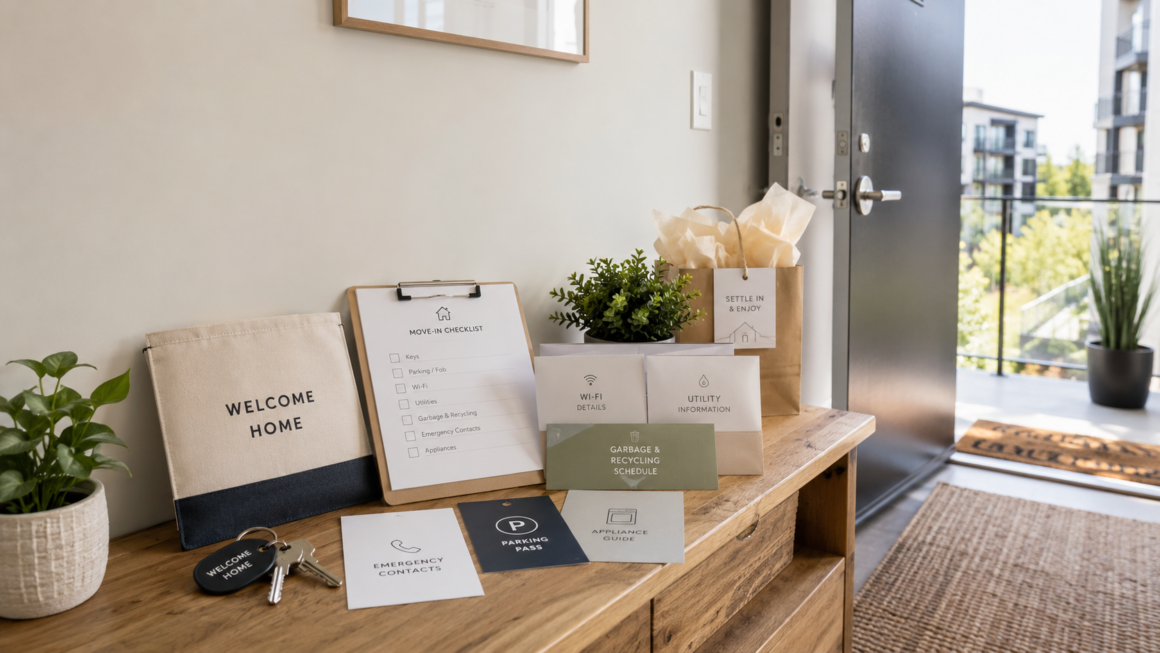

We wrote a move-out package for our own tenant this past June. Four pages: the inspection time, room-by-room cleaning expectations, what counts as normal wear and tear, keys, utilities, and the deposit math down to the interest owed. It took an evening to write, and it only took an evening because of decisions made two years earlier, on the day he moved in. The key count was already on file. The move-in inspection report existed. The deposit amount and the exact date we received it were recorded.
So we worked backwards and wrote the other half. Below is the move-in package we would hand a new tenant, written so you can copy it, fill in the brackets, and send it.
Two halves to it, as with any handover. Part of what you give a tenant on day one is a legal duty with a clock attached and a penalty for missing it. The rest is free, optional, and the reason nobody phones you at 9pm about the recycling. The template covers both. The notes at the end cover what changes province by province, because some of this genuinely does.
Key takeaways
- Copy the template, replace everything in [brackets], delete what does not apply, and email it before move-in day rather than handing it over at the door.
- The legally required items are the tenancy agreement copy, the condition inspection report where your province requires one, and any province-specific notices. Everything else is optional and does most of the work.
- Deadlines for the agreement copy: 21 days in BC, Alberta, Ontario and Manitoba, 10 days in Nova Scotia, at signing in Quebec. Alberta and Ontario let the tenant withhold rent until it arrives.
- Waste collection is municipal, not provincial, so that section has to be rewritten for every city you rent in.
- Ask for a one-line reply confirming receipt and keep it. A document the tenant never received is a document you never gave.
How to use this template
Everything in this template should be customized to your unique scenario. That said, items in [square brackets] are yours to fill in. Everything in the section headed “Before you send it” is for you, not the tenant, and should not be pasted into what you send.
Send it by email, ideally three or four days before move-in day so the tenant can arrange utilities and internet in time. Attach the tenancy agreement to the same email. Ask for a short reply confirming they got it.
MOVE-IN PACKAGE
Everything you need for a smooth move-in
| Property | [Unit number, street address, city, province] |
| Tenant | [Tenant name(s)] |
| Tenancy start date | [Day, date] |
| Inspection (walk-through) | [Day, date] at [time] |
| Who you’ll meet | [Your name, or the name of your representative and their role] |
Hi [Tenant name],
Welcome, and thanks for choosing [property address]. We’ve put this together so you know what to expect on move-in day and where to find everything in the first few weeks. Keep it somewhere you can find it again, because the filter sizes and the recycling schedule are in here.
If anything is unclear, get in touch before [move-in date] and we’ll sort it out together.
1. The move-in inspection (walk-through)
We’ll meet you at the unit on [day, date] at [time] to do the walk-through together before you start moving anything in.
At the walk-through:
- We’ll complete the [Condition Inspection Report / condition report] together, going room by room and noting the condition of everything, including anything already marked or worn.
- You’ll both sign it and you’ll get a copy [on the spot / within X days].
- Note anything you disagree with directly on the form. It is your record as much as ours.
- We’ll hand over the keys and access devices listed in Section 2.
Tip: take your own date-stamped photos or a video of the empty unit before you move furniture in. We’ll be doing the same. Two matching sets of photos is the simplest way to avoid a disagreement about condition two years from now.
2. Keys and access devices
Here’s what you’re receiving on move-in day. We’ll count these together and both initial the list, and the same count applies when you move out.
| Item | Number given |
| Unit / door keys | [ ] |
| Mailbox key | [ ] |
| Building fob or entry card | [ ] |
| Garage remote | [ ] |
| Storage locker key | [ ] |
| [Other] | [ ] |
Please don’t have extra copies cut without letting us know first, and if anything is lost during the tenancy, tell us right away so we can arrange a replacement. Replacement costs for unreturned keys or fobs at move-out may be deducted from the deposit.
Access codes:
- Building entry code: [code]
- Buzzer: press [number]. It rings through to [phone number], so update it with us if your number changes.
- Smart lock code: [code]. [Note who else holds a code.]
- Alarm code: [code and disarm instructions]
3. How to reach us
We’ll set up a group chat on [WhatsApp / your preferred app] with you, [names] and anyone else on the lease. That’s the easiest way to reach us day to day, and it means everyone sees the same message and you can send a photo of a problem instead of describing it.
For anything urgent, call [name] at [phone number]. An emergency is anything that puts the property or your safety at risk: a burst pipe or major leak, no heat in winter, a gas smell, a fire, no water, a broken lock or door that won’t secure, or a sewage backup. Call us at any hour for those, and for a gas smell or fire, call [911 / the gas utility emergency line] first.
For anything else, the group chat is fine and we’ll get back to you [within one business day]. A dripping tap, a slow drain, a fridge making a new noise, a burnt-out bulb in a fixture you can’t reach: message us and we’ll book it in.
One thing to note: for anything official, such as a notice of entry, a rent increase, or a notice to end the tenancy, we’ll email you rather than message the chat, and we’d ask you to do the same. Those documents have rules about how they’re delivered, so email keeps both of us covered. Your email on file is .
4. Utilities and internet
Utilities in your name. Please open accounts for the following, effective [tenancy start date]:
- Electricity: [provider, account setup link or phone number]
- Gas / heat: [provider, or “included in rent”]
- Water / sewer: [provider, or “included in rent”]
- [Other]
Set these up a few days ahead, since transfers are not always same-day and [month] is a busy period for the utilities.
Included in your rent: [list anything you cover, so there’s no ambiguity].
Internet. [Choose one and delete the rest:]
- Included in rent: the network is [name] and the password is [password]. It’s on a [provider] plan. If it goes down, message us and we’ll deal with the provider.
- In your name: the building is serviced by [providers]. [Note if only one provider can service the unit, or if an install requires drilling and needs our written approval first.] Book your install early, since appointments in [city] can run [X] weeks out.
Other accounts and apps: [laundry app, thermostat app, parking app, amenity booking system, with setup instructions].
5. Garbage, recycling and organics
Collection in [city] is run by the city, and the rules are stricter than a lot of people expect.
- Collection days: [garbage: day] · [recycling: day] · [organics/green bin: day]
- Where the bins live: [location]
- When they go out: [e.g. “by 7am on collection day, back in by end of day”]
- What goes where: [brief note, especially anything counterintuitive: food scraps are not allowed in the garbage here, soft plastics go to a depot, etc.]
- Holiday changes: collection shifts around statutory holidays. The schedule and a reminder signup are at [link to city collection calendar].
- Bulky items and extras: [how to book a large-item pickup, whether extra bags need tags, where the nearest depot is].
6. Rent
- Amount: $[amount] per month
- Due: the [first] of each month
- How to pay: [pre-authorized debit through PendoPay / e-Transfer to email / other]
If you’d like to set up pre-authorized debit, we can get the mandate signed at the walk-through and you’ll never have to think about it again. It’s entirely optional and there’s no difference in what you pay either way.
Receipts are available any time you ask for one.
7. Your deposit
- Security deposit: $[amount], received [date]
- [Pet damage deposit: $[amount], received [date]]
We hold this for the length of the tenancy [and it accrues interest at rates set annually by [authority]]. At move-out, you’ll get it back in full if the unit is clean, undamaged beyond normal wear, all keys are returned and rent is up to date. We’ll send you a full move-out package closer to the time so nothing about that process is a surprise.
8. Living in the unit
What we look after: [structural repairs, appliances, plumbing, heating, anything the tenancy legislation puts on us].
What we’d ask you to look after: [light bulbs, keeping drains clear, changing filters, snow clearing if applicable, keeping the unit reasonably clean and ventilated].
Filter sizes, so you can buy the right one without measuring:
- Furnace filter: [size], changed roughly every [X] months. [Where it is.]
- Fridge water filter: [model number]
- Range hood filter: [size or “washable, run it through the dishwasher”]
Things worth knowing about this unit:
- Heat: [type, and how to run it well. Baseboard heat, radiators and forced air all behave differently.]
- Breakers: [where the panel is, and anything odd about what it controls]
- Water shutoff: [location]
- [Any quirk: the window that sticks, the outlet on a GFCI, the parking gate that needs a hard press]
Insurance: [required / strongly recommended]. Our policy covers the building, not your belongings or your liability. Tenant insurance in [province] typically runs [$X to $Y] a month. [If required, note the coverage amount and that you’d like to see confirmation.]
House rules: [smoking, pets, balcony use, quiet hours, alterations, subletting, anything else. Write down every rule you intend to enforce, including anything you’d normally just mention in conversation.]
9. Parking and storage
- Parking stall: [number, location]
- Visitor parking: [where, how long, whether a pass is needed]
- Storage locker: [number, location, and how to get to it]
- Bike storage: [location and access]
Move-in day checklist
- Walk-through completed and the condition report signed, with your copy in hand
- Your own photos taken before furniture goes in
- Keys, fobs and remotes counted and received
- Group chat set up
- Utility accounts open, effective [date]
- Internet install booked
- Rent payment method set up
- Address updated with Canada Post, your bank, your employer and your insurer
Questions before [move-in date]? Get in touch and we’ll be glad to help.
[Your name(s)] [Phone number] · [Email]
Before you send it: what changes by province
This part is for you. Delete it from anything you send the tenant.
The tenancy agreement copy
Every jurisdiction below expects the tenant to walk away holding a copy of what they signed, and none of them treat it as a nicety. The duty attaches to written agreements only.
| Where | The deadline, and the cost of missing it |
| Ontario | Standard Form of Lease for most tenancies signed since 30 April 2018, copy within 21 days of signing. Ignore a written demand for 21 days and the tenant withholds a month’s rent, keeps it 30 days later, and can end a fixed term on 60 days’ written notice. |
| Alberta | 21 days after the signed agreement comes back to you. No mandatory standard form, but until the copy is delivered the tenant may withhold rent. |
| British Columbia | 21 days from signing. Form RTB-1 already carries every standard term. A tenant left without a copy can apply for dispute resolution. |
| Manitoba | 21 days from the tenant signing, and house rules bind only if given in writing. Fixed terms also need the renewal agreement issued at least three months before the end date. |
| Nova Scotia | At signing, or within 10 days. Form P’s statutory conditions govern the tenancy whether or not you used the form. |
| Quebec | The TAL form and its Section G notice, at the time the lease is entered into. |
Quebec’s Section G deserves its own paragraph, because it feels like arming the other side. It requires you to disclose the lowest rent paid for that dwelling in the previous 12 months. If the last tenant paid $1,410 and the new one is paying $1,540, that gap goes in the box. Fill it in and the tenant has 10 days to apply to the TAL to have the rent fixed. Leave it blank and the window becomes two months. A false notice makes it two months from the day the tenant realises. Three situations are exempt: a co-operative renting to its own member, a building in residential use for under five years, and low-rental housing.
Section 1, the inspection
- British Columbia. Required at the start and end of tenancy. You must offer at least two opportunities to attend, complete the report together, and give the tenant a copy within seven days. Fail to do it properly and your right to claim against the deposit for damage can be extinguished, regardless of the condition of the unit at the end.
- Alberta. Required within one week before or after the tenant takes possession, with a copy to the tenant.
- Manitoba. A condition report is required at the start of the tenancy, with a copy to the tenant.
- Ontario and Quebec. Not required. Which does not mean unnecessary. If a dispute reaches the LTB or the TAL, you are relying on whatever evidence you happened to keep, and a dated report signed by both parties is the cheapest evidence you will ever collect. Keep the section in the template.
Section 7, the deposit
This is where a lease template downloaded from the internet is most likely to be wrong.
| Where | What you can hold |
| British Columbia | Security deposit up to half a month’s rent, plus a separate pet damage deposit up to half a month’s rent. Interest accrues at rates set annually by the RTB. |
| Alberta | Up to one month’s rent, held in a trust account, with interest payable annually. |
| Ontario | No security or damage deposit permitted. A rent deposit of up to one rent period is allowed and must be applied to the last month, with interest paid annually at the guideline rate. |
| Quebec | No deposit permitted, and you cannot require post-dated cheques. |
| Manitoba | Security deposit up to half a month’s rent, plus a pet damage deposit. |
| Nova Scotia | Up to half a month’s rent, held in trust. |
Whatever you collect, record the amount and the exact date received on day one. Two years later, that date is what the interest calculation hangs on.
Section 5, waste collection
Rewrite this section for every city you rent in. It is municipal, not provincial, which is why it is the item most likely to be wrong in a national template. A few examples of how different it looks:
- Burnaby and the rest of Metro Vancouver. Food scraps are banned from the garbage, so the green cart is not optional.
- Toronto. Green bin, blue bin, garbage, bins out by 7am, tags required for extra bags.
- Montreal. Collection days are set by borough and change between them, and the July 1 moving date generates its own bulky-item pickups.
- Calgary. Three carts, with the green cart weekly in the warm months and every two weeks over winter.
- Halifax. Garbage goes out in clear bags, with limited exceptions.
Section 6, rent
In Ontario and Quebec you cannot require post-dated cheques or automatic payments as a condition of renting. A tenant may agree to pre-authorized debit voluntarily, and most will if you offer it as the easy option, but the template language has to offer rather than require. The wording in Section 6 is written that way already.
Section 8, house rules
In Manitoba, house rules bind a tenant only if given in writing. Tell an incoming tenant the balcony is no-BBQ because of your insurance, leave it out of the agreement, and by July you are asking rather than requiring. That works if the tenant is reasonable and not at all if they are not. Write down every rule you intend to enforce, in every province.
One more thing you owe, in Ontario
If you did not use the Standard Form of Lease, you owe the tenant information about landlord and tenant rights and the role of the LTB, on or before the day the tenancy begins. Most landlords use the LTB’s Information for New Tenants brochure. It is free and it takes one line in your email.
Make it provable
A document the tenant never received is, in practice, a document you never gave.
- Email the package rather than handing it over at the door. An email carries a date. A door does not.
- Ask for a one-line reply confirming receipt, and keep it. That reply is your evidence if a deadline is ever argued.
- File the sent copy somewhere that survives a phone upgrade and a staff change. The record has to live in a system, not in a thread.
Pendo Rent tip: A move-in package is only worth the paper if you can show you sent it. Pendo Rent is Canadian-built, so the tenancy agreement, the dated delivery record, the condition inspection report and the PendoPay mandate all hang off one tenant file. When a tenant asks for their agreement in month nine, or a tribunal asks exactly when you served it, that is a ten-second answer instead of an evening in your sent folder. Tenant Screening with Certn runs in the same place, so the applicant file and the tenancy file never diverge.
Frequently asked questions
How long does a landlord have to give a tenant a copy of the lease? Twenty-one days in British Columbia, Alberta, Ontario and Manitoba, and ten days in Nova Scotia. Quebec deals with the lease form and its Section G notice when the lease is entered into. The duty attaches to written agreements only.
Do I have to do a move-in inspection? In British Columbia, Alberta and Manitoba, yes, and BC adds the strongest consequence: get it wrong and you can lose the right to claim against the deposit for damage. Ontario and Quebec do not require one, which simply means that if a dispute arises you are relying on whatever evidence you happened to keep.
What should be in a new tenant welcome package? The legally required documents first: the agreement on the correct form, the condition report where required, and any province-specific notices. Then keys with a count, an emergency contact, the waste collection schedule, internet and access codes, utility switchover dates, filter sizes, parking and storage, and the rent method set up. The second list is optional and does most of the work in keeping week one quiet.
This article is for informational purposes only and does not constitute legal advice. Rules differ by province and municipality and change over time. Always consult your local residential tenancy authority or a qualified legal professional for advice specific to your situation.
Make the handover repeatable
A move-in package that lives in one person’s head does not survive a busy September.
Renting out one or two units? Fill the template in once and it is done. Pendo Rent holds the agreement, the delivery record, the inspection report and the payment mandate on a single tenant file, so nothing has to be rebuilt from memory next time. Start a free 30-day trial.
Managing a portfolio? The risk is not one forgotten filter size, it is fifty move-ins a year handled slightly differently by four people. Book a demo and we’ll show you how the same package goes out every time, with a dated record anyone on your team can pull up.