
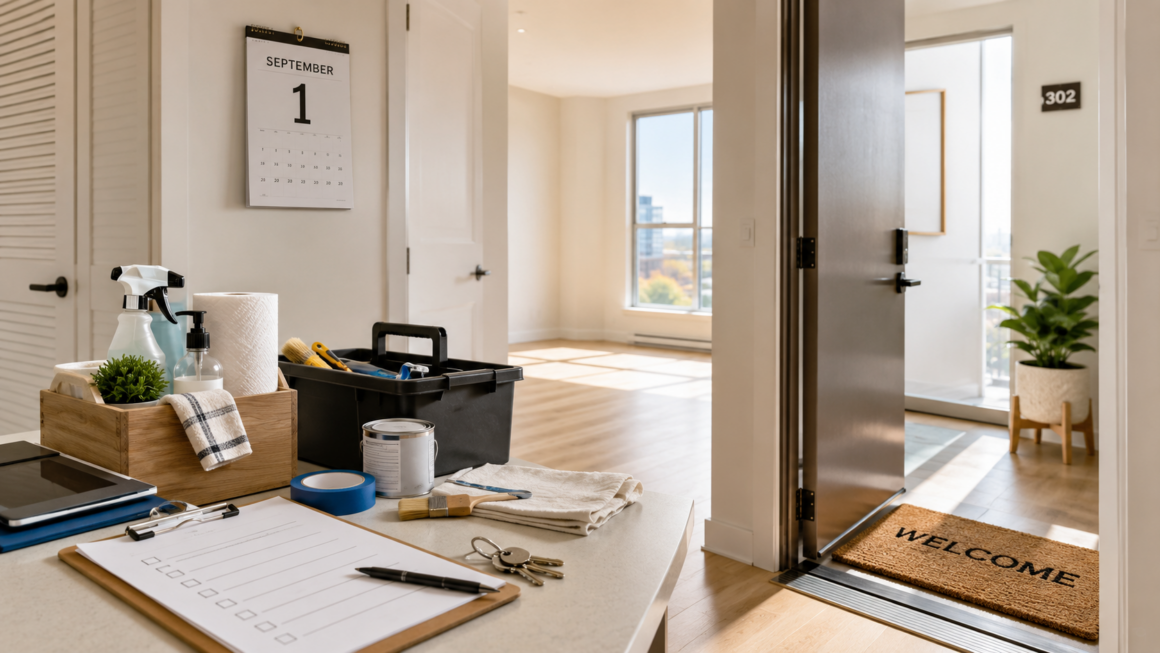

September 1 has a way of compressing weeks of landlord admin into one long weekend.
The outgoing tenant is still carrying boxes downstairs. The cleaner needs access. A loose faucet has appeared out of nowhere, and the incoming tenant already has movers booked.
The solution is not to move faster on August 31. It is to close the old tenancy fully before opening the new one, with enough time between them to inspect, repair, clean, and test the unit.
Key Takeaways
- Confirm the legal end date, possession time, inspection process, and deposit rules for your province.
- Do not send cleaners or contractors in until the outgoing tenant has left and the unit’s condition has been documented.
- Prioritize lawful possession, safety, and essential repairs before cosmetic work.
- Complete the new lease, inspection appointment, payment setup, and building instructions before move-in day.
- Archive the former tenant’s lease, ledger, notices, photographs, and inspection reports instead of deleting them.
Your Sept. 1 rental turnover checklist
| Timing | Task |
| Three to four weeks before | Confirm the tenancy end date, possession time, inspection process, forwarding-address instructions, and key return |
| Two weeks before | Book the cleaner, contractors, elevator, loading area, and both inspection appointments |
| One week before | Confirm the incoming lease, payment method, utilities, building instructions, and key inventory |
| Move-out day | Obtain vacant possession, inspect the unit, take photographs, and collect keys, fobs, remotes, and parking passes |
| Turnover window | Complete safety work, repairs, cleaning, testing, and final photographs |
| Move-in day | Complete the new condition report before furniture arrives, provide copies, and hand over access devices |
| After move-in | Process the former tenant’s deposit and archive the complete tenancy record |
Three to four weeks before move-out
Start with the tenancy paperwork, not the cleaning appointment.
Review the tenant’s notice, the lease, and any written agreement about the move-out. Confirm the final date, when possession must be returned, how the inspection will be scheduled, and where the tenant should send their forwarding address.
Avoid relying on a loose plan such as “sometime on August 31.” Put the dates, times, and responsibilities in writing.
If the unit is still being advertised, you can state that it is available September 1 with the handover time to be confirmed. Once the lease is signed, however, the possession commitment should be clear. “Time to be confirmed” should not become an escape clause when the incoming tenant already has a truck and moving crew booked.
For units that are not yet rented, Pendo Rent’s guide to listing a rental in Canada can help you choose where to advertise without scattering applications across too many channels.
One to two weeks before the handover
Book the outgoing and incoming inspections as separate appointments. Then confirm the cleaner, any required contractors, and building access.
For a condominium or strata property, check:
- Elevator reservations and move fees
- Loading-area restrictions
- Parking arrangements
- Required move forms
- Building hours and access rules
Prepare one turnover folder containing the original inspection report, current lease, tenant notices, key inventory, maintenance history, incoming lease, and emergency contacts.
A condition inspection should be completed using the process and forms required in the province. In British Columbia, for example, landlords are responsible for arranging move-in and move-out inspections, and failing to follow the inspection requirements can affect the landlord’s right to claim against a deposit.
Pendo Rent’s move-in and move-out inspection tool lets landlords add timestamped photographs, compare the move-out report against the original move-in condition, and provide signed copies.
Move-out day: document first
Do not send the cleaner in as soon as the outgoing tenant carries out the last box.
First, confirm that possession has been returned. Collect all keys, fobs, remotes, parking passes, and mailbox keys. Then complete the inspection before cleaning or repairs alter the unit’s condition.
Walk through the property in the same order as the original report. Check:
- Walls, doors, windows, floors, and blinds
- Cabinets, counters, plumbing, and appliances
- Required smoke and carbon-monoxide alarms
- Storage areas, balconies, parking, and outdoor spaces
- Final utility readings, where applicable
Take a wide photograph of each room, followed by close-ups of any concern. Keep the images focused on the rental’s condition. Avoid capturing personal documents, medication, financial information, or other unnecessary tenant details.
Separate damage from ordinary wear before deciding whether a claim is appropriate. Document what you see first. Review the evidence, lease, inspection records, and provincial rules second.
If the outgoing tenant has not left
Stop the turnover. Do not change the locks, remove belongings, send cleaners into an occupied unit, or give the unit to the incoming tenant.
Contact the outgoing tenant in writing, check the possession and enforcement process for the province, and update the incoming tenant immediately. In British Columbia, an Order of Possession does not authorize a landlord to physically remove a tenant or change the locks before lawful enforcement. Ontario also prohibits a landlord from recovering possession unless the tenant has vacated, abandoned the unit, or the proper eviction process has been completed.
The turnover window: use the right order
Once the unit is vacant and documented, work through it in this order:
- Address safety, security, plumbing, electrical, heating, and habitability concerns.
- Complete necessary repairs and maintenance.
- Clean the unit.
- Test appliances, locks, lights, plumbing, ventilation, and required alarms.
- Take final photographs.
- Prepare the move-in report and key package.
A cosmetic paint touch-up should not delay a secure lock, working toilet, water-leak repair, or required safety device.
Leave a buffer where possible. A same-day turnover gives you no room for a broken appliance, cancelled cleaner, late contractor, or tenant who is slow to leave.
When a delay affects the incoming tenant, communicate early. Explain what happened, what parts of the unit are affected, and when they will receive the next update.
Selected provincial deposit rules
Deposit and rent-payment rules vary significantly across Canada. These examples do not cover every province or territory.
| Province | Rule to confirm before turnover |
| British Columbia | After the tenancy has ended and the landlord has received the forwarding address in writing, the landlord generally has 15 days to return the deposit with applicable interest, obtain written consent for a deduction, or apply for dispute resolution. |
| Alberta | The landlord generally has 10 days after possession is returned to refund the deposit or provide a statement or estimate of deductions. If an estimate is used, a final statement and remaining balance are due within 30 days after the tenancy ends. |
| Ontario | A rent deposit must be applied to the final rent period. It is not a damage or cleaning deposit. A landlord also cannot require automatic bank debit as a condition of the tenancy. |
| Quebec | A landlord cannot require a security, furniture, or key deposit, or more than the first rent-payment period in advance. |
| Nova Scotia | The landlord generally has 10 days after the tenancy ends to return the security deposit, obtain written permission for a deduction, or submit the province’s Security Deposit Claim Form. |
These rules are supported by the current guidance and legislation published by British Columbia, Alberta, Ontario, Quebec’s Tribunal administratif du logement, and Nova Scotia Residential Tenancies.
Before handing over the new keys
Complete as much onboarding as possible before move-in day:
- Signed provincial lease and permitted deposit records
- Agreed rent-payment method
- Move-in inspection appointment
- Parking, waste, elevator, and building instructions
- Emergency and maintenance contacts
- Key, fob, and remote inventory
- Any tenant-insurance requirement included in the lease and permitted in the province
When using pre-authorized debit, give the tenant time to review and authorize the arrangement. Do not introduce it as a surprise during the key handover. Ontario law specifically says a lease cannot require automatic debiting, although the parties may choose an agreed payment method voluntarily.
Pendo Rent’s comparison of e-Transfer and pre-authorized debit for rent explains the operational differences between the two methods.
Complete the incoming condition report while the unit is still empty. Give the tenant a copy, record every access device provided, and show them how to report maintenance issues.
Common Sept. 1 turnover questions
Can one tenant move in the same day another moves out?
It may be possible, but it leaves almost no room for a proper inspection, cleaning, repairs, or delays. A separate turnover window is safer.
Can a landlord deduct cleaning costs from a deposit?
It depends on the province, the evidence, the inspection records, and whether the cleaning goes beyond ordinary use. Follow the province’s required claim process rather than making a deduction automatically.
Can keys be withheld until extra fees are paid?
Rent and permitted deposits should be collected according to the signed lease and provincial rules. Do not make key release conditional on an unauthorized cleaning, damage, administration, key, or other extra deposit.
What if the tenant leaves belongings behind?
Do not immediately throw them away or leave them at the curb. Provinces have different rules for abandoned property, notice, storage, and disposal.
A calmer handover starts before August 31
A smooth turnover follows a simple sequence: close the former tenancy, document the unit, complete the necessary work, and then open the new tenancy.
Pendo Rent helps landlords keep inspections, leases, payment setup, tenant records, and archived history connected to the right property. When a tenant moves out, archiving the profile instead of deleting it preserves the lease, ledger, inspection photographs, and payment history.
Start a free 30-day trial today and keep your next turnover checklist, inspections, tenant records, and rent setup in one place.
Disclaimer: This article is for informational purposes only and does not constitute legal advice. Always consult your local Residential Tenancy Branch or a qualified legal professional for advice specific to your situation.