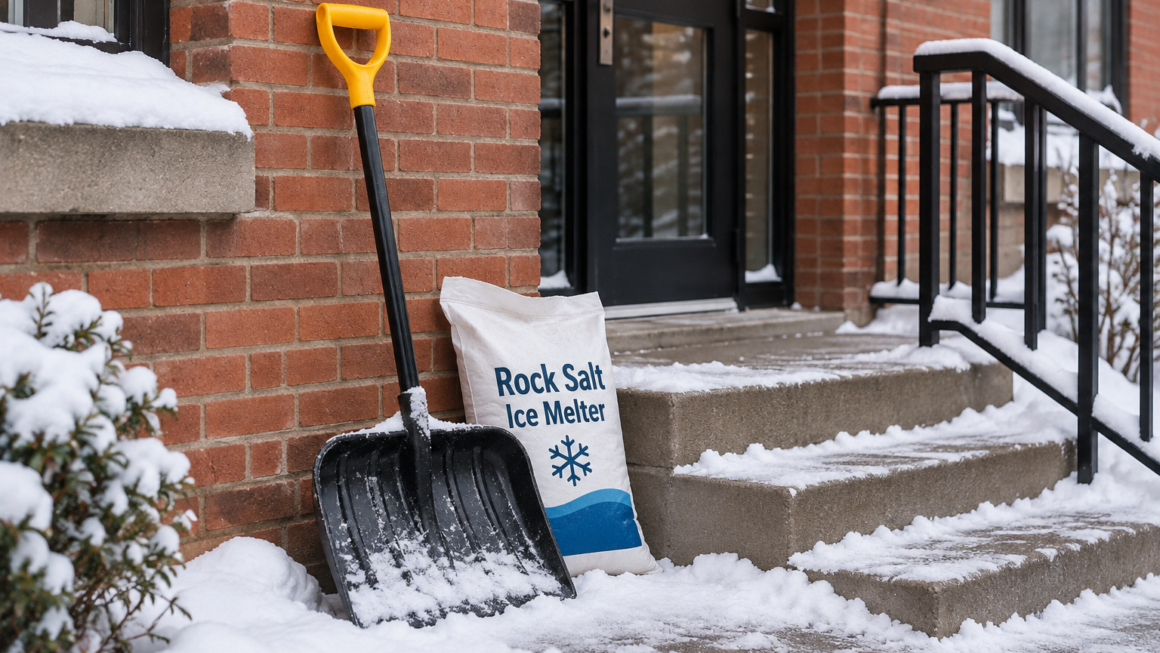

This guide is for Canadian landlords, tenants and small property managers who want to settle who shovels before the first storm. In Manitoba and BC, the landlord clears shared walkways in a multi-unit building, while tenants may be responsible for snow in areas they use exclusively. Ontario and Quebec give more weight to the lease, within legal limits.
On top of that, cities set their own sidewalk deadlines. Vancouver requires snow and ice to be cleared by 10 a.m. the day after a snowfall, Calgary allows 24 hours after snowfall ends, and Toronto’s requirements depend on how much snow has fallen.
Key Takeaways
- In Manitoba and BC, landlords clear shared walkways, stairs and common areas of multi-unit buildings, while tenants may be responsible for snow removal in exclusive-use areas.
- A lease can assign certain snow-clearing duties, but it cannot override provincial maintenance laws or municipal sidewalk bylaws.
- City deadlines vary: Vancouver requires sidewalks cleared by 10 a.m. the day after a snowfall, Calgary gives 24 hours after snowfall ends, and Saskatoon allows 48 hours for residential properties.
- In one Ontario case (Cannon, 2017), a landlord with a reasonable winter maintenance program successfully defended a slip-and-fall claim.
- Write snow-removal responsibilities area by area, and keep dated records of clearing and ice treatment.
Tenancy Law vs. City Bylaws: Two Different Questions
Provincial tenancy laws and municipal sidewalk bylaws answer two different questions, and landlords sometimes mix them up.
Tenancy rules determine maintenance responsibilities between landlords and tenants. Municipal bylaws establish who must clear public sidewalks and who may face enforcement when those sidewalks become unsafe.
A landlord may assign certain snow-clearing tasks to a tenant through a valid agreement and still have responsibilities under local bylaws.
Across the jurisdictions checked for this article, the rules fall into two tenancy models, with city bylaws as a third layer.
Model 1: The Landlord Clears Shared Areas, the Tenant Clears Exclusive Ones
Manitoba’s Residential Tenancies Branch says a landlord must clear snow from sidewalks and stairs in a multi-unit complex, except for areas tenants use exclusively. The landlord must also clear enough snow to give tenants access to their parking stalls.
Clearing individual parking stalls is the landlord’s responsibility only if the landlord and tenant have agreed to that service.
A tenant in a single-family house is responsible for routine yard maintenance, which the Branch defines to include shovelling snow. Tenants in townhouses, duplexes or triplexes with exclusive-use yards are also generally responsible for routine maintenance of those areas, although the parties may agree to other arrangements.
British Columbia draws a similar line.
RTB Policy Guideline 1 (July 2025) says tenants are generally responsible for routine yard maintenance, including snow clearing, if they live in a single-family dwelling, or in a townhouse or multi-family dwelling where they have exclusive use of the yard.
Landlords are responsible for snow clearing in common areas of multi-unit residential complexes and manufactured home parks.
The guideline addresses rental-property maintenance, not the separate municipal requirements for public sidewalks.
Model 2: The Lease Decides, Within Limits
Ontario and Quebec give more weight to the agreement, but landlords cannot use a lease to avoid responsibilities imposed by law.
In Crete v. Ottawa Community Housing Corporation (2024 ONCA 459), the Ontario Court of Appeal upheld a lease clause making a townhouse tenant responsible for clearing snow and ice from steps used exclusively by that household.
The court found the provision did not conflict with Ontario’s Residential Tenancies Act because the area was not an exterior common area.
The distinction matters.
In Montgomery v. Van (2009 ONCA 808), the court found that a lease clause requiring a tenant to clear snow from a common area conflicted with the landlord’s statutory maintenance responsibilities and was therefore void.
The Crete decision reaffirmed that distinction: landlords must maintain exterior common areas free of unsafe snow and ice, while a properly drafted lease can assign clearing duties for areas reserved for a tenant’s exclusive use.
A separate snow-clearing service agreement may raise different legal questions, but it does not automatically remove the landlord’s statutory obligations.
Another Ontario decision shows why maintenance records matter.
In Cannon v. Cemcor Apartments Inc. (2017 ONCA 378), the landlord retained responsibility for the parking lot and successfully defended a slip-and-fall claim. The court considered its winter maintenance program, the contractor’s work, and evidence of the actual parking lot conditions when the incident occurred.
Quebec also uses the lease to identify responsibilities.
The Tribunal administratif du logement (TAL) provides a standard lease form with sections identifying who is responsible for snow and ice removal from parking areas, balconies, entrances, walkways, driveways and stairs.
However, landlords still have legal maintenance and safety obligations under the Civil Code of Québec. A lease provision cannot simply eliminate those duties.
If a landlord fails to provide a service required under the lease, a tenant may seek remedies through the TAL, depending on the circumstances.
Model 3: The City Sets the Clock
Saskatoon’s Sidewalk Clearing Bylaw 8463 gives residential properties 48 hours after snowfall and non-residential properties 24 hours.
Calgary requires public sidewalks bordering private property to be cleared to a bare surface within 24 hours after snowfall ends.
The City can fine a property occupant $250 for a first offence, $500 for a second and $750 for a third or subsequent offence within 12 months.
Calgary also states that owners of rental properties are responsible for arranging for snow and ice removal when they reside elsewhere. Owners may also receive bills for City-arranged clearing.
Toronto’s rules depend on snowfall depth.
Under the City of Toronto’s sidewalk-clearing requirements:
- For snowfall under 2 cm, residents and businesses must clear adjacent public sidewalks within 12 hours after snowfall ends.
- At 2 cm or more, the City clears public sidewalks.
- Under the separate Property Standards Bylaw, property owners must clear snow and ice from private-property areas, including driveways, parking spaces, steps, ramps and landings, within 24 hours after snowfall ends.
In the Lower Mainland, the clock can be shorter.
Vancouver’s Street and Traffic Bylaw requires the owner or occupier of a property to clear snow and ice from the full width of adjacent public sidewalks by 10 a.m. the day after a snowfall.
The City can enforce this requirement and arrange clearing at the responsible party’s expense. Vancouver has also reported fines ranging from $250 to $750 for violations.
Other BC municipalities, including Burnaby, Richmond, Surrey, Victoria and North Vancouver, have their own snow-clearing requirements. Check the current municipal bylaw rather than assuming Vancouver’s deadline applies.
Some cities clear public sidewalks themselves. In Halifax, the municipality has been responsible for clearing all public sidewalks in the region since 2013, when council took the job over from property owners. By-law S-300 still applies to owners and occupiers: it prohibits throwing or piling snow onto the street or sidewalk.
The important distinction: A municipal bylaw may place responsibility on an owner, occupier or both. That does not automatically settle who must perform the work under the tenancy agreement.
For example, in a BC multi-unit building, the landlord is responsible for shared rental-property areas under RTB guidance. Public sidewalks adjoining the property are separately governed by municipal bylaws.
Snow Removal Rules Across Canada: Quick Comparison
| Jurisdiction | Tenancy rule on who clears | City sidewalk deadline (example city) |
| British Columbia | Tenants generally handle routine snow clearing for single-family dwellings and exclusive-use yards. Landlords clear shared areas in multi-unit complexes. | Vancouver: by 10 a.m. the day after a snowfall. Check other municipalities individually. |
| Alberta | Confirm the agreement and applicable provincial maintenance requirements. | Calgary: 24 hours after snowfall ends. Owners of rental properties who live elsewhere must arrange clearing; occupants may receive fines. |
| Saskatchewan | Confirm responsibilities under provincial tenancy law and the agreement. | Saskatoon: 48 hours for residential and 24 hours for non-residential properties. |
| Manitoba | Landlord clears shared sidewalks, stairs and parking access in multi-unit complexes. Tenants generally handle routine snow removal at single-family homes and exclusive-use yards. | Check the applicable municipality. |
| Ontario | A lease may assign exclusive-use areas to a tenant (Crete, 2024). Landlords retain statutory responsibilities for exterior common areas (Montgomery, 2009). | Toronto: 12 hours for snowfall under 2 cm; City clearing at 2 cm or more. Private-property areas (Property Standards Bylaw): 24 hours. |
| Quebec | The standard lease identifies snow-clearing responsibilities, subject to the landlord’s legal maintenance obligations. | Municipal requirements vary. |
| Nova Scotia | Confirm duties under provincial tenancy law and the rental agreement. | Halifax: the municipality clears all public sidewalks. By-law S-300 bans throwing or piling snow onto streets and sidewalks. |
The table summarizes selected provincial guidance and municipal examples. Municipal rules are separate from tenancy obligations, and property-specific conditions may change who is responsible.
How to Write a Snow Clause That Works (Step-by-Step)
- List every area. Sidewalk, front steps, walkway to the door, driveway, parking stalls, shared stairs, balconies and any ramp.
- Assign each area to the responsible party. Under Manitoba and BC guidance, shared areas in multi-unit buildings remain the landlord’s responsibility. Identify tenant responsibilities only where supported by applicable law and the tenancy arrangement. Our rental agreement checklist shows where maintenance duties belong in a lease.
- Set a clear standard. Specify when clearing must begin, how ice will be treated, and who arranges additional work during prolonged storms. The schedule must meet applicable municipal deadlines and cannot override statutory maintenance obligations.
- Say who supplies what. Shovel, salt or sand, and who pays the contractor if you hire one.
- Check the city’s rule for your address. Deadlines differ by municipality, and some apply only to certain areas or when municipal clearing services are unavailable.
- Record each storm. Date, time cleared, who did it, what treatment was applied, and a photo.
Worked Examples
Example: A Six-Unit Walk-Up in Manitoba
Example: The landlord owns a six-unit building with a front walk, shared stairs and a rear parking lot.
Under Manitoba RTB policy, the walk, stairs and access to the parking stalls are the landlord’s responsibility.
The ground-floor tenant has a private patio, which may be treated as an exclusive-use area. Routine snow clearing there would generally fall to the tenant, subject to the tenancy arrangement and applicable maintenance requirements.
Individual parking stalls are the landlord’s responsibility only if the parties have agreed that the landlord will provide snow removal for those spaces.
Pendo Rent tip: A snow clause is more useful when you can find it and show what was agreed.
In Pendo Rent, landlords can keep leases and tenant records alongside payment and ledger information instead of searching through separate folders and emails. For landlords with units in several provinces, having the correct agreement attached to each tenancy makes it easier to confirm responsibilities when questions arise.
Common Mistakes
Treating the Lease as a Shield
A lease may assign some snow-clearing duties. It cannot override a landlord’s statutory obligations or automatically remove responsibility under municipal bylaws.
A clause that works for a tenant’s private steps may be unenforceable for a shared entrance.
Assuming a BC or Ontario Rule Travels
BC’s Policy Guideline 1 and Ontario’s case law apply within their respective jurisdictions.
Manitoba’s rules for multi-unit properties are similar to BC’s, but Quebec’s lease requirements and the municipal bylaws work differently.
If you own rentals in more than one province, review each property’s snow-clearing responsibilities individually.
Keeping No Record
In Cannon, the Ontario landlord successfully defended the claim based on evidence of its winter maintenance program and the actual conditions when the tenant fell.
A written maintenance plan is useful, but so is evidence that the work was carried out.
Check what your insurance policy covers for a fall on the property. Our post on rental property insurance explains the difference between landlord and tenant coverage.
Our winter property preparation guide and article on inspection records that hold up also offer practical ways to document maintenance and property conditions.
Frequently Asked Questions
Is the Landlord Responsible for Snow Removal in Canada?
It depends on the province, the property and the area being cleared.
In Manitoba and BC, landlords are responsible for snow clearing in shared areas of multi-unit buildings. Tenants generally handle routine clearing at single-family dwellings and exclusive-use yards.
Municipal bylaws may separately impose responsibilities for public sidewalks adjoining the property.
Can a Landlord Make a Tenant Shovel Snow?
In Manitoba and BC, tenants generally have responsibility for routine snow clearing at single-family homes and exclusive-use yards.
In Ontario, the Court of Appeal upheld a lease provision assigning snow removal on a townhouse’s private steps to the tenant in Crete (2024).
However, a landlord cannot simply transfer statutory common-area maintenance obligations through a lease clause.
Elsewhere, check the applicable provincial tenancy requirements.
Who Is Responsible for Snow Removal in a Manitoba Rental?
The landlord is responsible for shared sidewalks, stairs and parking access in a multi-unit complex.
Tenants in single-family homes are responsible for routine yard maintenance, including snow clearing. Tenants with exclusive-use yards in certain multi-unit properties are generally responsible for those areas, subject to the agreement.
These responsibilities are outlined by the Manitoba Residential Tenancies Branch.
Who Clears Snow in a Quebec Rental?
Quebec’s standard lease form identifies which party is responsible for removing snow and ice from specific areas.
Landlords still have obligations under the Civil Code of Québec, and lease terms cannot eliminate duties imposed by law.
A tenant whose landlord fails to provide a required snow-removal service may seek remedies through the Tribunal administratif du logement.
Who Has to Shovel the Sidewalk at a Rental in Vancouver?
Vancouver’s bylaw places responsibility on the owner or occupier to clear snow and ice from the full width of adjacent public sidewalks by 10 a.m. the day after a snowfall.
For shared areas within a multi-unit rental property, the landlord is responsible under BC RTB guidance.
For a single-family home or an exclusive-use yard, routine snow-clearing responsibilities are addressed separately under tenancy guidance.
Who Clears the Sidewalk at a Rental Property in Halifax?
The Halifax Regional Municipality has cleared all public sidewalks in the region since 2013, when council took the job over from property owners.
Owners and occupiers still have to follow By-law S-300, which prohibits throwing or piling snow onto the street or sidewalk.
Who clears the property’s own walkways and driveway is a separate question. Check Nova Scotia’s tenancy requirements and the rental agreement.
Can a Tenant Be Fined if the Sidewalk Isn’t Cleared?
Yes, depending on the municipality.
In Calgary, the property occupant may receive a fine starting at $250 for failing to clear an adjacent sidewalk within the required time.
The property owner is still responsible for ensuring the sidewalk is cleared and may be billed if the City arranges the work.
Disclaimer: This article is for informational purposes only and does not constitute legal advice. Always consult your provincial residential tenancy office or a qualified legal professional for advice specific to your situation.
Next step: Keep the lease clause, tenant records and rent ledger for every unit in one Canadian-built system. Start a free 30-day trial today.