
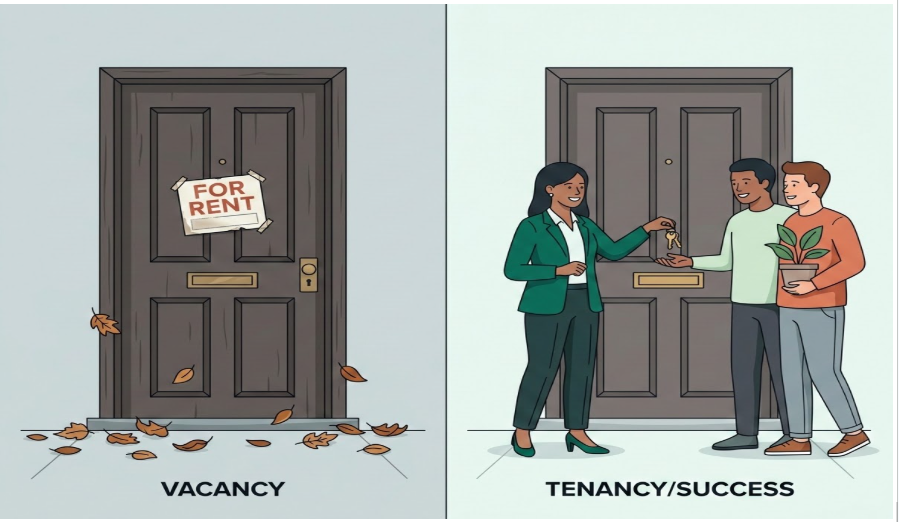

For the first time in years, Canadian tenants have options. National asking rents have now fallen for 20 straight months, and vacancy rates in Vancouver and Toronto in particular are at levels not seen in decades. If your unit has been sitting empty for three weeks, the obvious move is to slash the price. It’s also frequently the wrong first move, and in a rent-controlled province, one you may not be able to undo.
Key Takeaways
- Canada’s purpose-built rental vacancy rate climbed to 3.1% in 2025 (from 2.2% in 2024), and asking rents fell 4.7% year over year to $2,029 in May 2026.
- Every vacant month on a $2,000 unit costs $2,000. A $100/month rent cut costs $1,200 a year. Do the math before doing either.
- In BC and Ontario, rent increases on sitting tenants are capped, so a lowered base rent can stay low for years. One-time incentives protect your base rent.
- Speed fills units: responding to inquiries within hours and screening in days, not weeks, beats a price cut in most cases.
- Your cheapest vacancy is the one that never happens. Renewals cost a fraction of turnovers.
What changed in Canada’s rental market
According to CMHC’s 2026 mid-year rental market update, the national purpose-built vacancy rate rose to 3.1% in 2025, its highest level in years, with Vancouver at 3.7% (its highest since 1988) and Toronto at 3.0%. New buildings completed after 2020 are sitting emptiest; operators report some units taking months to fill. Meanwhile, Rentals.ca’s June 2026 national rent report puts average asking rent at $2,029 as of May, down 4.7% from a year earlier, the 20th consecutive month of annual declines. BC and Ontario have dropped fastest, at 5.9% and 5.2% respectively.
Translation: tenants are comparison shopping again, and slow landlords are paying for it in empty months. Owners of older units and family-sized suites have more pricing power than the headlines suggest, since CMHC found those segments still tight. Panic pricing hits hardest where it’s needed least.
Should you lower the rent to fill a vacancy?
Sometimes, but do the arithmetic first. One vacant month on a $2,000 unit costs you $2,000. Dropping the asking rent by $100 costs $1,200 over a one-year lease, and in BC or Ontario, where annual increases on a sitting tenant are capped (Ontario’s 2026 guideline is 2.1%), that discount compounds for as long as the tenant stays. A price cut that fills the unit two weeks sooner loses money. A price cut that prevents two more empty months earns it.
Here’s the same decision side by side, for a $2,000/month unit in a rent-controlled province:
| Cut the rent by $100 | Offer a half-month move-in credit | |
| Year-1 cost | $1,200 | $1,000, once |
| Year-2+ cost | $1,200+ per year (increases capped at the guideline) | $0 |
| Base rent afterward | $1,900, hard to raise back | $2,000, intact |
| Signal to applicants | Price is negotiable; wait and it may drop again | Move-in bonus with a firm price |
The strategies below usually deserve a shot before the base rent moves at all.
How to fill the unit before touching the price (step by step)
1. Win the first 48 hours
Prospective tenants message five listings and rent from whoever answers. Respond within hours, offer same-day or next-day viewings, and have your application process ready to go. In a market where new towers are offering months of free rent, an indie landlord’s speed and personal touch are legitimate competitive advantages.
2. Fix the listing, not the price
Fifteen bright, phone-quality-or-better photos, an accurate floor plan, and a first line that names the three things your tenant segment cares about (parking, pets, in-suite laundry). A mediocre listing at $1,950 loses to a great listing at $2,000 every week of the summer. And if you’ve been holding out on pets, reconsider: pet-friendly rentals attract a wider pool and see shorter vacancy windows, since most Canadian renters have a pet.
3. Use one-time incentives instead of base-rent cuts
Half a month free, a $500 moving credit, or a free parking spot for six months all sweeten the deal without lowering the rent you’ll collect in year two. Large operators know this: market reports show most new Toronto rental buildings now offer incentives rather than cutting posted rents. The incentive expires; a lowered base rent, under rent control, effectively doesn’t.
4. Screen fast, but screen
The pressure to fill a unit is exactly when landlords skip verification, and a nonpaying tenant costs far more than an extra vacant month, there’s a reason a full screening process pays for itself. The fix is speed, not shortcuts: run credit and background checks that come back in hours rather than days. Pendo’s tenant screening, powered by Certn, turns that step around quickly enough that good applicants don’t drift to a faster landlord while you wait.
5. Retain the tenant you already have
Industry estimates put a full turnover at several thousand dollars once you count cleaning, painting, re-listing, and the empty weeks in between. Start renewal conversations 90 days out, fix small issues fast, and consider skipping an allowable increase for a reliable tenant. Keeping a good tenant at $1,950 beats finding a new one at $2,050 in almost every scenario that includes a vacant month.
Common mistakes
- Panic pricing in week three. One dramatic cut signals desperation and resets your base rent. If you must adjust, move in $50–$75 steps.
- Slow replies. A five-day gap between inquiry and viewing loses more tenants than a $50 price difference.
- Skipping screening under pressure. An empty month is recoverable; a nonpaying tenant plus a tribunal timeline is not. One bad approval can erase a year of rent — one landlord’s cautionary tale here.
- Ignoring your sitting tenants. The renewal you didn’t start in April becomes the vacancy you’re marketing in July.
A tale of two vacancies
Two landlords in Burnaby list similar one-bedrooms at $2,100 in the same week. Landlord A waits five days between inquiry and viewing, gets nervous after week three, and drops to $1,950; the unit rents in week five. Landlord B holds at $2,100, replies to every inquiry the same day, offers a half-month move-in credit, and screens applicants in 48 hours; the unit rents in week two. Over one year, A collects roughly $21,450 after the vacant month; B collects about $24,150 after the credit. Same building. A $2,700 difference, and B’s base rent is $150 higher forever.
Final thought
Vacancy is expensive, but cutting rent too quickly can be expensive too.
The better order is simple: improve the listing, respond faster, reduce move-in friction, keep screening consistent, then adjust the rent only when the evidence points there.
For indie landlords and small property managers, the advantage is not always having the cheapest unit. It is making the rental feel clear, safe, and easy to say yes to.
Pendo helps Canadian landlords keep leases, tenant details, screening, rent collection, receipts, and ledgers organized in one place. Start a free 30-day trial today, or contact us for a demo.
FAQs
How long should I let a unit sit before lowering the rent?
If two weeks of active marketing brings inquiries but no applications, your listing or viewing process is the problem. Inquiries near zero usually means price. Adjust in small steps rather than one dramatic cut.
Do rental incentives attract bad tenants?
Not if screening stays intact. A move-in credit attracts deal-seekers; approving someone without verified income attracts problems. Those are separate decisions.
Can I raise the rent back later if I drop it now?
For a sitting tenant in a rent-controlled province, only by the annual guideline. Check your province’s current rules before repricing.
My market is still tight. Does any of this apply?
Rents rose over the past year in Saskatchewan, Manitoba, Nova Scotia, and Newfoundland. If that’s you, retention and speed still pay, but resist over-discounting; your pricing power is real.
Vacancy is won on speed, and speed is a systems problem. Pendo brings listings, screening with Certn, leases, and PendoPay rent collection into one place, so the next vacancy closes in days. Start a free 30-day trial today or contact us for a demo if you’d like a walkthrough first.